
What Are the Benefits of Forest Bathing (Shinrin-yoku) — Mental, Immune & Heart Health
April 20, 2026
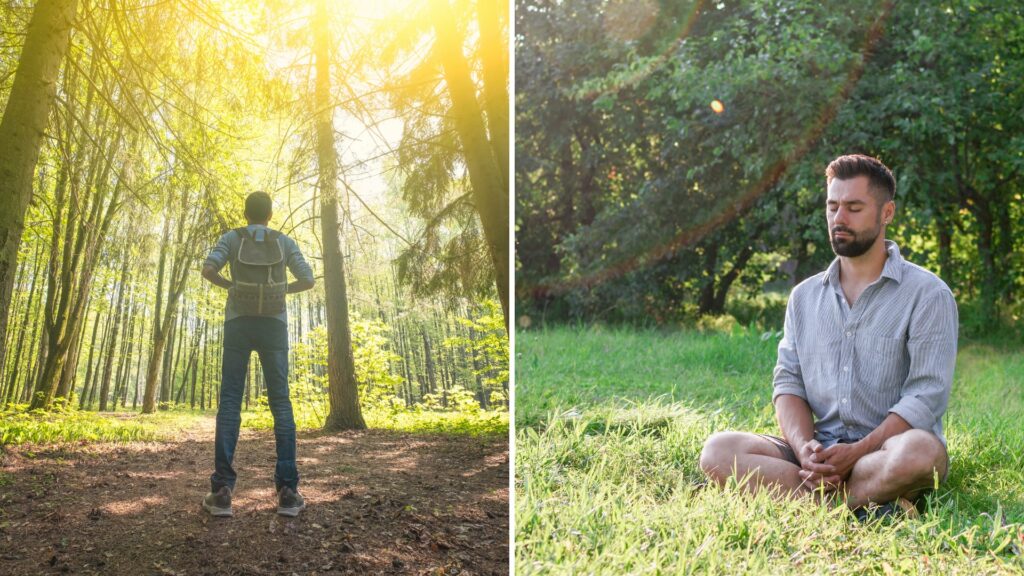
Forest bathing, or Shinrin-yoku, is the Japanese practice of slow, sensory immersion in a wooded environment. You move at a crawl, leave the phone in your pocket, and pay attention to what your eyes, ears, nose, and skin are picking up from the forest around you. No summit, no distance, no agenda beyond noticing.
Here at Healing Pines Recovery, we’ve seen what happens when a man who’s spent years outrunning his own thoughts finally slows down enough to hear the wind move through pine branches. If you’re reading this, you may be looking for ways to lower stress, sleep better, or support a recovery plan without adding another medication to the list.
The research on forest bathing is promising, and the practice itself is free, accessible, and surprisingly hard at first.
This article walks through what the science actually shows about mental, immune, and heart health benefits, who responds best to sensory nature practice, and how to start. If you’re weighing whether nature-based work fits into a broader treatment plan, our outdoor experiential therapies page offers a clinical frame for how we use it at our Elizabeth, Colorado facility.
Key Takeaways
- Short visits produce real physiological shifts. Sessions of 15 to 30 minutes are associated with lower cortisol, reduced heart rate, and improved mood; longer or repeated visits may support immune and sleep benefits.
- The evidence is strongest for mental health, not cure claims. Meta-analyses report meaningful short-term reductions in anxiety, depression, and anger. Long-term outcomes remain an active research area.
- For men, sensory practice may open doors talk therapy alone can’t. A 2022 study of middle-aged males found forest bathing increased serotonin, improved sleep, and reduced depressive symptoms.
- Forest bathing is an adjunct, not a replacement. It complements individualized clinical care, dual-diagnosis treatment, and relapse-focused therapy rather than substituting for them.
What Forest Bathing Is (And How It’s Different From Hiking)
The practice was formalized in Japan in 1982 by Tomohide Akiyama, then director of the Japanese Ministry of Agriculture, Forestry, and Fisheries. It was a public-health response to rising urban stress. Over the next four decades, researchers built a body of work on its physiological and psychological effects, now collectively studied under the term “forest medicine.”
You’re not covering distance. You’re paying attention to bark texture, filtered light, the temperature of the air, and the layered sounds of a forest that usually slip past unnoticed.
For men who have spent years muscling through problems by force of will, the unhurried nature of forest bathing tends to feel unfamiliar at first. That unfamiliarity is part of what makes it useful. There’s no winning, no metric, no “good session.” There’s only what you notice.
Forest Bathing vs. Hiking vs. Mindfulness: A Quick Comparison
| Dimension | Forest Bathing | Hiking | Mindfulness Meditation |
| Primary goal | Sensory immersion, stress reduction | Distance, fitness, summit | Attention training, present awareness |
| Pace | Very slow (1–2 mph or less) | Moderate to fast | Stationary |
| Setting | Wooded environment required | Any trail | Anywhere |
| Typical duration | 20 minutes to 3 hours | 1 to 8 hours | 5 to 60 minutes |
| Physical intensity | Minimal | Moderate to high | None |
| Best for | Autonomic recovery, emotional thaw | Cardiovascular fitness, exploration | Cognitive regulation, habit formation |
Forest bathing and mindfulness meditation share a lot of DNA. Both involve slowing down and noticing. The difference is that forest bathing leans on the environment to do the work of attention-focusing, which is why many men find it easier as an entry point. You don’t have to “empty your mind.” You just have to look at a leaf.
Mental Health Benefits: Stress, Anxiety, Depression, and Mood
The strongest evidence for forest bathing sits in the mental health domain. A 2022 systematic review and meta-analysis published in the International Journal of Mental Health and Addiction examined 20 shinrin-yoku studies. It found consistent short-term reductions in anxiety, depression, anger, and stress, with the largest effects seen for anxiety.
A separate 2023 meta-analysis in the International Journal of Mental Health Nursing pooled data from 36 studies and 3,554 participants. It also found that forest bathing significantly reduced depression and anxiety symptoms compared to control conditions.
The evidence base is largest for short-term psychological outcomes and smallest for long-term physiological change.
For readers in early recovery, the most useful finding is practical: elevated stress, emotional suppression, and disrupted sleep are the conditions where forest bathing seems to help most. These are also the exact conditions many men enter treatment with, which is why our holistic therapy approach folds sensory nature practice into clinical programming.
Why the Mental Health Evidence Matters for Men Specifically
A 2022 study by Li and colleagues examined forest bathing specifically in middle-aged males. The findings were striking:
- Increased serum serotonin levels
- Reduced depressive symptoms
- Improved subjective sleep quality
- Greater feelings of vigor and reduced fatigue on the POMS test
This cohort matters because it overlaps with the population most likely to enter men-specific addiction treatment.
Many of the men we work with at Healing Pines have lived with depression or anxiety for years without naming it. The emotional language wasn’t available.
What sensory immersion appears to do, based on the research and on what we observe clinically, is lower physiological arousal enough for that language to start forming. It doesn’t replace therapy. It makes therapy more productive.
For men who also carry co-occurring conditions, this pairs naturally with dual-diagnosis treatment, where addiction and mental health are treated as one integrated picture.
How Forest Bathing Affects the Autonomic Nervous System
The body keeps two parallel control systems:
- Sympathetic nervous system (fight-or-flight)
- Parasympathetic nervous system (rest-and-digest)
Chronic stress, and substance use in particular, tips this balance toward sympathetic dominance: elevated heart rate, shallow breathing, high cortisol, and poor sleep.
Cortisol and the Stress Response
Multiple controlled studies report reduced salivary and serum cortisol after forest exposure.
For someone in early recovery, where cortisol spikes are closely tied to craving and relapse risk, this physiological shift has practical implications.
Parasympathetic Activation and Heart Rate Variability
Forest exposure is associated with increased heart rate variability and reduced resting heart rate. Both are markers of vagal tone and parasympathetic activity.
Effects are typically modest after a single short session and appear to strengthen with repetition. That repetition piece matters. The research supports a consistent weekly rhythm more than a single long retreat.
What the Physiological Shift Feels Like
Clinically, the autonomic shift often shows up as easier breathing, a noticeable drop in jaw or shoulder tension, and, for many men, an unexpected quieting of the inner monologue. You may not feel “better” the first time. You may feel bored, restless, or skeptical. Those are normal entry-point reactions that tend to soften with consistency.
Immune Benefits: Natural Killer Cells and Phytoncides
Some of the most frequently cited forest bathing research focuses on immune function. Studies led by Qing Li in Japan have reported increases in natural killer (NK) cell activity and intracellular anti-cancer proteins such as perforin, granulysin, and granzymes following multi-day forest trips.
The effects appear to last roughly 7 to 30 days after exposure.
The proposed mechanism involves phytoncides. These are volatile organic compounds trees release as part of their own defense systems. When inhaled, phytoncides appear to influence immune cell behavior, though the exact mechanisms are still being mapped.
The evidence here is suggestive rather than conclusive. For men in recovery, immune research isn’t the main reason to take up forest bathing. The mental health and autonomic findings are better supported and more directly relevant.
Heart Health and Sleep Outcomes
Controlled trials consistently report short-term reductions in systolic and diastolic blood pressure and heart rate after forest visits. A 2015 study by Ochiai and colleagues looked specifically at middle-aged males with high-normal blood pressure and found meaningful acute reductions following forest therapy.
Sleep Improvements
Multiple studies report improved subjective sleep quality after forest bathing sessions. The Li 2022 middle-aged male study used the Oguri-Shirakawa-Azumi sleep inventory and found participants reported better recovery from fatigue on waking.
Sleep is an underrated piece of early recovery. Poor sleep tracks closely with craving intensity, emotional dysregulation, and treatment dropout.
Anything that makes sleep easier, without medications that carry their own risks, is worth paying attention to. This is part of why we treat physical wellness as a core pillar rather than a nice-to-have. Our blog post on physical wellness and addiction recovery walks through how sleep, exercise, and nutrition work together during treatment.
How Long Should a Session Be?
The research supports a flexible, “any amount helps” approach with a loose target for people seeking measurable effects.
| Session Length | What the Research Supports | Best For |
| 5–10 minutes | Quick mood lift, immediate stress reset | Daily maintenance, stressful workdays |
| 15–30 minutes | Cortisol drop, heart rate reduction, mood improvement | Weekly rhythm, most common research protocol |
| 60–90 minutes | Deeper autonomic shift, better subjective recovery | Guided sessions, weekend practice |
| 2–3 hours | Immune markers (NK cells), phytoncide exposure | Occasional deeper sessions, retreats |
| 120+ minutes per week (cumulative) | Population-level wellbeing benefits | Sustainable long-term target |
A 2019 Scientific Reports study by White and colleagues examined nearly 20,000 participants and found that spending at least 120 minutes per week in nature was associated with better self-reported health and well-being.
The threshold appeared whether the time was accumulated as one long visit or split across shorter outings, which is useful news if your schedule doesn’t allow long retreats. For men in our program, that 120-minute threshold is easy to hit just walking the 40-acre wooded property between clinical sessions.
Forest Bathing as Men-Specific Emotional Thaw Work
This section is where the research meets the clinical reality of treating men for substance use and co-occurring conditions. It’s also where forest bathing becomes something more specific than a wellness trend.
Why Sensory Practice Tends to Reach Men Differently
Many men arrive in treatment having learned, from a young age, to manage emotion by not feeling it. Anger is acceptable. Almost nothing else is. By the time substance use has taken hold, there’s often a decade or more of compressed affect that needs somewhere to go.
Traditional talk therapy asks men to identify, name, and articulate feelings they’ve spent years avoiding. This is necessary work, but it’s often where men get stuck early in treatment.
The vocabulary isn’t there. The body is still braced against the question.
Sensory nature practice moves differently. It doesn’t ask you to articulate anything. It just asks you to notice. For many men, that lower demand is what lets the nervous system drop out of defense mode for the first time in years.
The Physiological Case for Nature Before Language
The research we’ve covered (cortisol reductions, parasympathetic activation, serotonin increases in middle-aged males, sleep improvements) all points to the same underlying shift: the body settles before the mind does.
For men who’ve spent years in chronic activation, that physiological permission to feel has to come before the cognitive work can land.
Master’s-level clinicians on our team often frame this sequence as “regulate, then relate, then reason,” a neurobiological hierarchy drawn from trauma-informed care. Forest bathing operates at the “regulate” layer. It’s not a substitute for the relating and reasoning that happen in individual and group therapy. It’s the floor those therapies need to stand on.
For men with layered trauma histories, this sequence matters even more. Evidence-based modalities like EMDR therapy for trauma and addiction work best when the body is first regulated enough to tolerate the processing work.
How We Use Nature-Based Work at Healing Pines
Our 40-acre wooded property in Elizabeth, Colorado, about an hour from Denver and Colorado Springs, isn’t incidental to treatment. It’s infrastructure. Men in our men’s only rehab program have daily access to forest, open sky, and animal-assisted therapy spaces that support the same nervous-system regulation research describes.
We pair sensory outdoor time with clinical work across CBT, DBT, family therapy, and dual-diagnosis care. The outdoor pieces aren’t recreation. They’re part of an integrated residential inpatient treatment plan built around how men actually heal.
A typical sequence might involve a 60-minute guided outdoor session in the morning, an individual therapy session where a clinician helps a man connect what he noticed outside to something he’s carrying, and a later group where that same thread can be processed with peers.
The outdoor work primes the clinical work. The clinical work gives the outdoor work meaning. For men processing trauma, our approach to trauma-informed care recognizes that regulation has to precede disclosure.
Guided Forest Therapy vs. Unguided Walks
There’s no single right way to practice forest bathing, and for most men, some of both tends to work best.
| Feature | Guided Forest Therapy | Unguided Walks |
| Structure | Facilitator leads sensory invitations | Self-directed |
| Typical duration | 2–3 hours | 15 minutes to 2+ hours |
| Best for | Trauma-sensitive work, first sessions, deeper processing | Daily practice, maintenance, busy schedules |
| Cost | Moderate to higher | Free |
| Accessibility considerations | Often addressed in advance | You manage your own |
| Clinical oversight | Possible with credentialed guides | None unless integrated into a program |
| Typical facilitator credential | Association of Nature and Forest Therapy (ANFT) certified | N/A |
If you’re new to the practice, a guided session is a good starting point, especially if you’re processing trauma or managing significant anxiety. If you’re maintaining a practice over time, unguided walks in a familiar green space are what make it sustainable.
Urban Parks and At-Home Alternatives When Forest Access Is Limited
Not everyone has a wooded property to walk onto. The research suggests that meaningful benefits are still available at smaller doses in less-forested environments.
Nearby parks, tree-lined neighborhoods, and urban green spaces produce smaller but real physiological and psychological benefits. The effect size is smaller than deep forest immersion, but it’s accessible and repeatable, which matters more over the long run.
For indoor or low-access situations, options include plant-rich rooms with low-allergen species, window views of natural scenes, and guided audio sessions that structure sensory attention in whatever space you have.
Phytoncide diffusers exist commercially, but their long-term safety data is limited, and they can trigger asthma or allergies in sensitive users.
How to Practice Forest Bathing: Three Session Templates
The point of these templates isn’t precision. It’s giving you a structure to start with so you’re not standing in the woods wondering what to do.
Before You Go
Choose a safe, accessible green space close to home. Dress in layers. Bring water, a phone for emergencies (on silent), and something to sit on. Set an intention that’s not outcome-based: “I’m here to notice,” not “I’m here to feel better.”
The 5–10 Minute Reset
Use this for stressful workdays, between appointments, or as a morning ritual:
- Walk slowly for one minute to transition out of task mode
- Pick one sense and spend the remaining time with it
- End with six slow breaths, feet planted
- Optional: one sentence in a notes app about what you noticed
The 30-Minute Restorative Session
Use this as a weekly baseline:
- Slow transition walk (3 minutes)
- Cycle through three senses (5 minutes each)
- Seated breathing practice (10 minutes)
- Brief journaling or reflection (2 minutes)
The 2-Hour Immersion
Use this occasionally for deeper work:
- Slow arrival walk (10 minutes)
- Extended sensory immersion with seated pauses (60–90 minutes)
- Mindful eating if you bring food
- Closing reflection (15 minutes)
Accessibility, Safety, and Contraindications
Forest bathing works best when it works for your body. Check terrain for mobility fit and pollen counts if you have allergies. Carry prescribed inhalers or epinephrine if needed. Be aware of tick activity in grassy areas from spring through fall.
If you have severe PTSD, active psychosis, uncontrolled cardiac disease, or significant fall risk, talk to a clinician before unsupervised outdoor practice. Guided sessions with trauma-informed facilitators, or supervised outdoor time alongside physical fitness programming, are often a better starting point than solo walks for these populations.
Who Benefits Most and Who Should Take Extra Care
Forest bathing is generally low-risk and broadly accessible, but the research suggests some groups benefit most and some need to approach the practice with more planning.
Groups with the strongest research support:
- Adults with chronic stress
- People with prehypertension or controlled hypertension
- Adults with mild to moderate anxiety or depression
- Unpaid caregivers
- Men in early recovery with high baseline arousal and emotional suppression
Groups who should plan carefully:
- Individuals with severe PTSD (use guided, trauma-informed sessions)
- People with active psychosis (under clinical supervision only)
- Uncontrolled cardiac conditions (medical clearance first)
- Severe pollen, tick-borne illness, or chemical allergies
- Significant mobility or fall-risk limitations
If you’re not sure which group you’re in, a conversation with your clinician is the right first step. At Healing Pines, we often frame these questions within a broader look at men’s mental health and recovery, where nature-based work sits alongside clinical care.
Forest Bathing FAQs for Men in Recovery
What’s the difference between forest bathing and a regular hike?
Forest bathing is a slow, sensory-focused practice aimed at immersion rather than distance. A hike is a physical activity with a route and a destination. You can make a hike more forest-bathing-like by walking slowly and paying attention to your senses, but the practices have different goals and different physiological signatures.
How quickly should I notice benefits?
Mood and autonomic changes often appear within 15 to 30 minutes. Immune changes, when they occur, are measured after longer or repeated sessions. Population research suggests about 120 minutes per week of cumulative nature contact is associated with better self-reported health, so the consistency matters more than any single session.
Does forest bathing actually help addiction recovery specifically?
The direct research on shinrin-yoku for addiction is still limited. A 2020 commentary in Addictive Behaviors made the case that forest bathing’s effects on anxiety, stress, and depression justify further study in addiction populations.
What we observe clinically is consistent: nature-based practice tends to make other treatment components more accessible. It also pairs well with self-directed reset practices like Sober October, where many men first notice how much calmer their body feels without alcohol in the system.
Can forest bathing replace therapy or medication?
No. Forest bathing is an adjunct, not a primary treatment. For men with substance use disorders or significant mental health conditions, it works best alongside individualized clinical care, medication management when appropriate, and structured therapy.
What if I live somewhere without forests nearby?
Urban parks, tree-lined streets, plant-filled indoor spaces, and even guided audio sessions with natural sounds all produce smaller but real benefits. Regular small doses in a local park tend to outperform occasional big-trip retreats.
Are there any risks I should know about?
For most people, the risks are environmental (ticks, pollen, uneven terrain, weather exposure) rather than inherent to the practice. People with severe allergies, uncontrolled cardiac or psychiatric conditions, or significant mobility limitations should plan with a clinician.
Bringing Nature-Based Practice Into an Individualized Treatment Plan
Forest bathing can steady the body, soften the edges of chronic stress, and create enough internal space for the harder work of recovery to start landing. It’s one of the reasons we built our program on 40 acres of wooded Colorado land instead of in a clinical building.
If you or someone you love is considering men-focused inpatient treatment and wants to understand how outdoor experiential work fits alongside clinical care, we’re here to talk it through. Our admissions team can walk you through what a typical week looks like, how we coordinate with insurance, and whether our boutique approach is the right fit.
You can start at our admissions page or reach us directly by calling (720) 575-2621.